Why do a weekly yoga session with your horse?
3 minutes, nose down without lifting: that's the minimum time needed to achieve a quality, lasting postural stretch of your horse's back.
On the lunge, choose to work differently with MATH ®.
Discover MATH ®

The MATH ® is an innovative patented therapeutic system specially designed by an osteopath to ride alongside your horse, promoting optimal stretching of its back without the use of a bit.
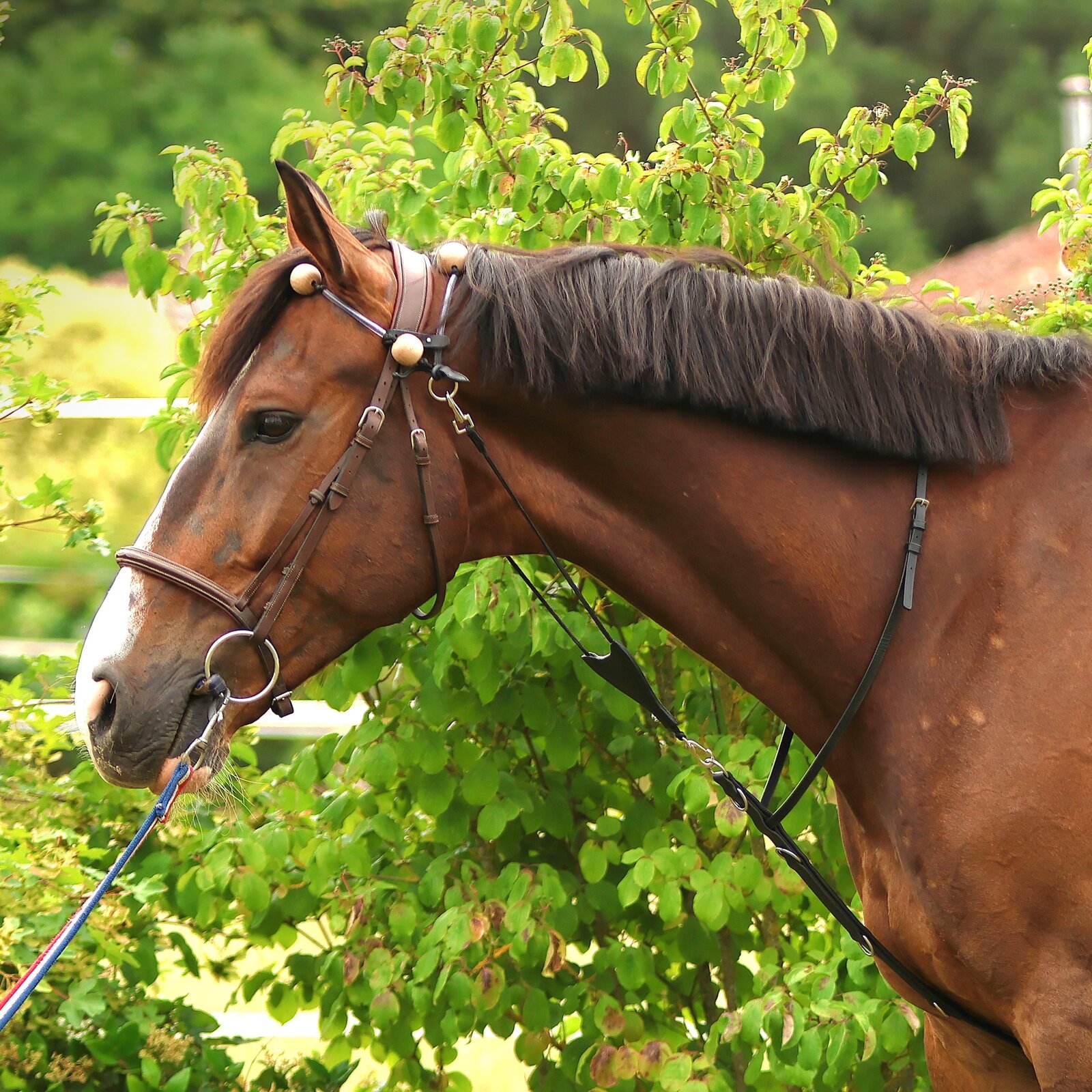
The upper balls, placed on the first cervical vertebra, stimulate the motor points of the cervical extensor muscles, naturally encouraging your horse to lower the neck and reach the nose forward. Frontal balls eliminate any over-pressure, ensuring maximum comfort.
Incorporating a specific session with "a yoga for the back" every week on the lunge is essential to avoid many pathologies. MATH ® allows quality groundwork. It is used at the trot only.
MATH ® requires precise and simple learning:
Facilitating exercises promote neck descent and mobilization of the spine (which you'll find in the videos). Always start on your horse's supple side and repeat each exercise 20 to 30 times on each rein.
- An explanatory time at standstill is decisive and essential: using resistance on the MATH ® in the middle, we'll encourage the head to lower. As soon as relaxation and lowering are obtained, reward your horse. Repeat this reflex several times to make it easier for the horse to understand. During the session, if the horse resists too much, we'll repeat this explanation.
- We'll mobilize at the walk, several times the hips outwards on a small circle (2 to 3 m), nose turned in, held fairly high to create an extension of the spine. As soon as the inner hind leg is sufficiently mobilized, we'll release the hand and progressively widen the circle to encourage the neck descent.
- We'll repeat trot-walk transitions so that the horse perceives the release of tension. This will promote longitudinal mobilization of the spine and toning of the abdominals. One lap at the trot, 3-4 walk strides then trot again, etc.
Prolonged descent requires postural balancing and progressive lengthening of the thoracolumbar fascias, which is not immediate and will require several sessions.
Progressiveness and relaxation will be the basis for using MATH ®, to incite rather than constrain.
Progressive emphasis will be placed on engaging the hind legs under the mass, helped by working over ground poles. We'll obtain mobilization of the last lumbar vertebrae and vertical thrust through passing 6-7 ground poles set out in a V. To be done at every lunging session.
Benefits of Use
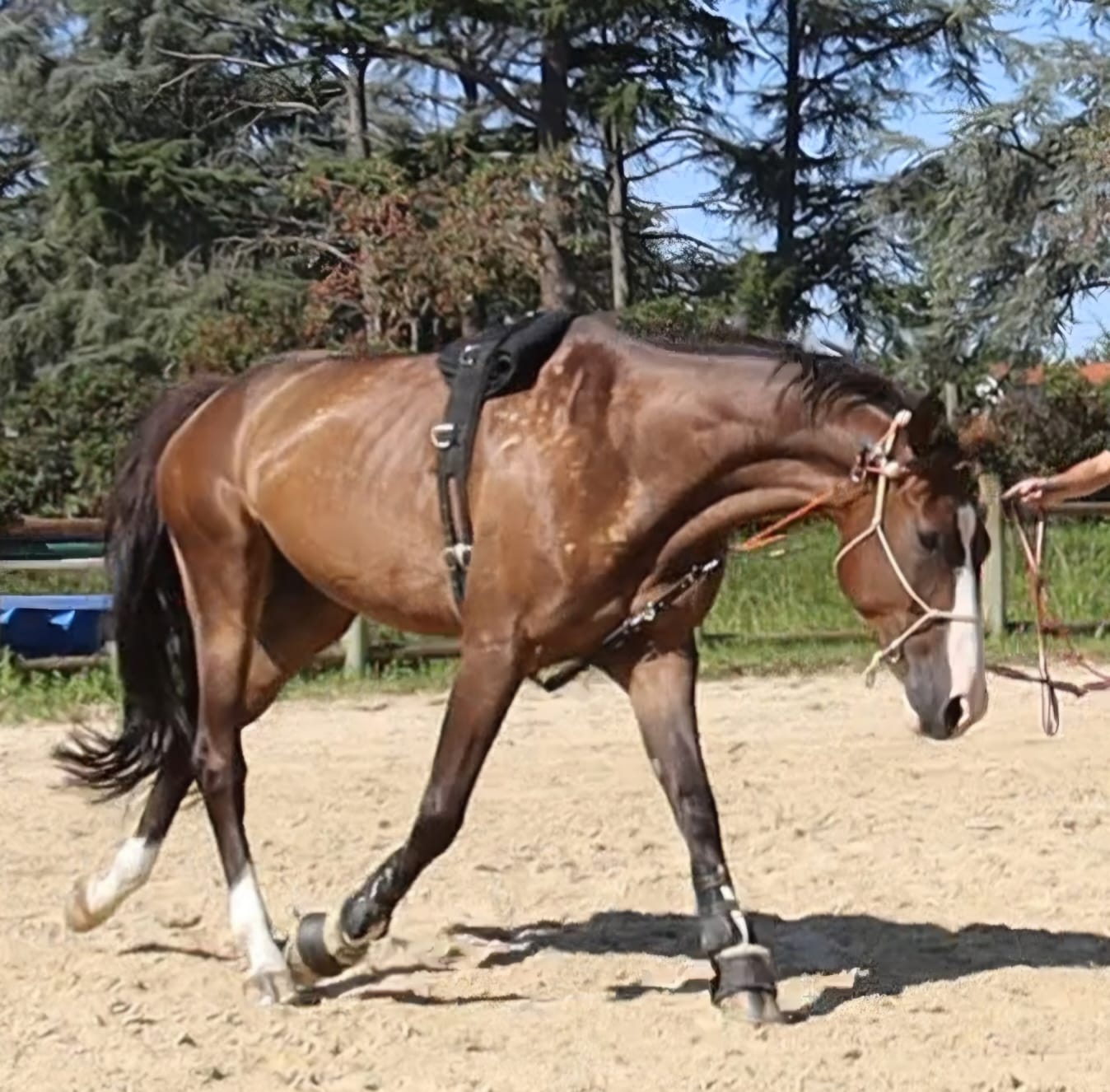
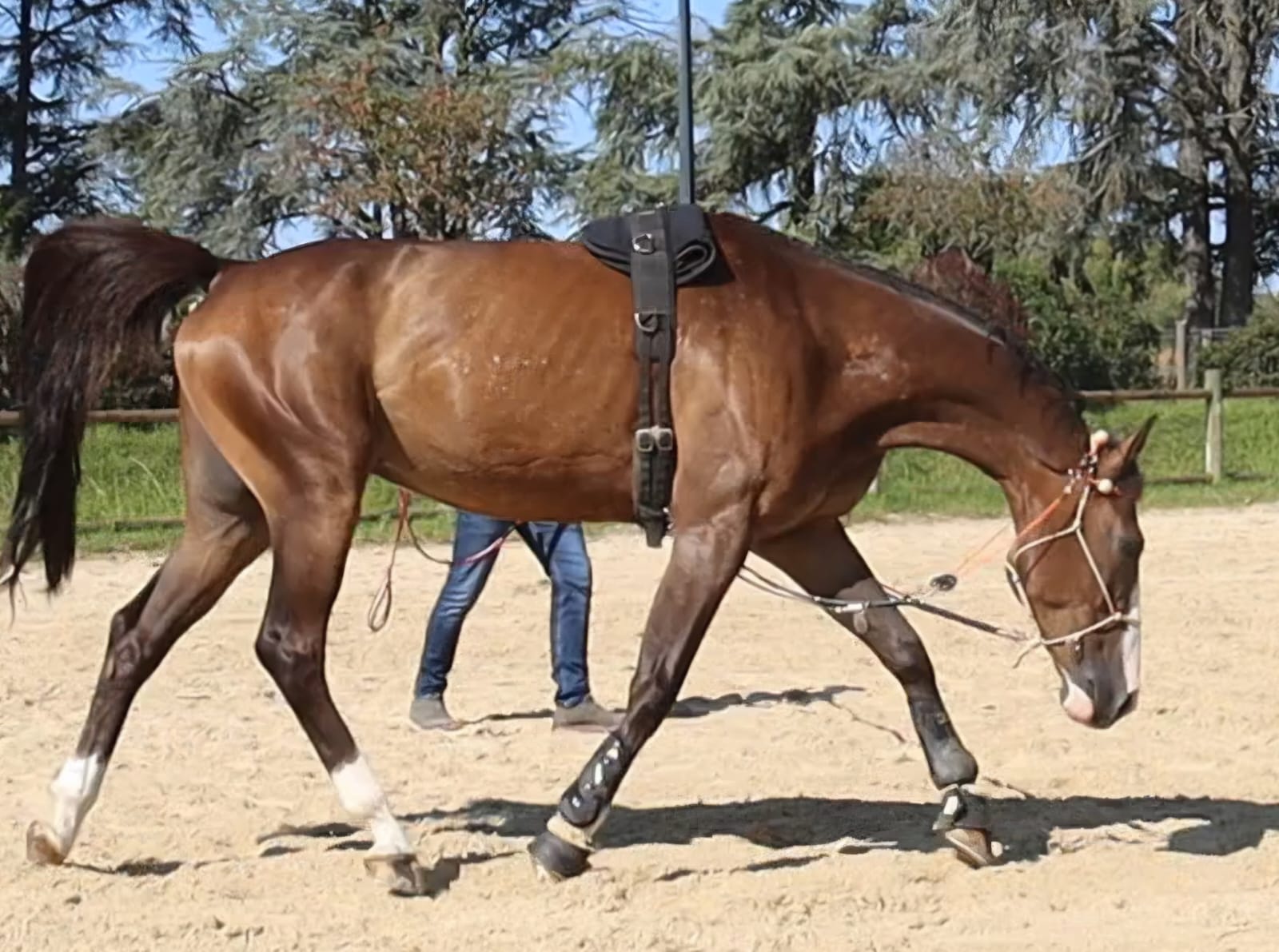
- Natural Neck Descent Without Constraint on the Mouth: MATH ® allows your horse to release the tip of the nose forward, facilitates shoulder mobility and so ensures a better connection under saddle. It will help horses that let go of the bit, struggle to stretch, or close up.
Opening the head-neck angle biomechanically promotes the rise of the withers and the stretching of the thoracic and, above all, lumbar muscles and fascias — something traditional draw reins do not allow. MATH ® has its place in treating pathologies such as overriding spinous processes ("kissing spines"), lumbago (sciatic-type pain), and after any local veterinary treatment or osteopathy session.
- Lasting Effectiveness and Posture: studies show that for a postural stretch to be effective over time, the posture must be held without release for at least 3 minutes. A horse worked on the lunge without a training aid very rarely manages to hold a low neck posture without an untimely raise. The results are then weak, which is exactly why an encouraging therapeutic system makes sense.
- Recommendations on the Lunge
- A specific weekly stretching session is highly recommended for the sport horse.
- Sufficient engagement, marked by the hind foot overtracking the front footprint, further opens the vertebrae from TH14 to TH18 and from L5 to the sacrum — areas often prone to pathologies — and is essential to avoid overloading the forelegs.
- The nose should stay at knee level, no lower — otherwise tension on the lower cervical vertebrae increases and tension on the suspensory ligaments is greatly heightened.
Easy to install
Installing the MATH ® is simple and quick. The upper balls are placed behind the headcollar or bridle (without a browband). The browband is adjustable to prevent any bouncing.
The tension length of the leather strap is set as follows: the highest point of the poll sits 5 to 10 cm lower than the highest point of the withers. You'll achieve this gradually over the first few uses.
Our usage videos and tipsGive your horse the best in lunging and stretching with MATH ®. Transform your approach and improve your companion's well-being with this unique innovation.
Order nowWhat is its history?
I'm Alexandre Le Guillanton, physiotherapist since 1995, human osteopath since 2002 and equine osteopath since 2006. I have always sought to complement my treatments with effective, long-lasting stretching, requiring postural maintenance without relaxation for more than 3 minutes.
Inspired Innovation
By using balls to recreate reflex stimulation on the motor points of the first cervical extensor muscles, I was able to reproduce the effect obtained with my fingers during consultations. This reflex stimulation encourages the opening of the head-neck angle and the overall flexion of the cervical vertebrae. With no constraint on the mouth and no bit, this achieves a natural descent of the neck, the tip of the nose towards the front, and optimal stretching of the thoracolumbar muscles and fascias.
The Evolution of MATH
MATH was born in 2022 and patented. The name MATH® is an abbreviation of my daughter's first name, Mathilde. Internationally, it is known as the "THERAPEUTIC EQUINE LUNGING SYSTEM", thanks to the impetus of Mary Cook. After numerous versions and improvements, the MATH ® is ready for commercialization in 2024.
The solution for Cavaliers
MATH ® addresses a common problem: your horse suffers from recurring back or lumbar pain. Rehabilitation is simple on the lunge: lower the neck with engagement. Many riders struggle to hold their horse's neck down for long enough. Horses generally hold this posture for only a few tens of seconds, whereas 3 minutes, without lifting, is required for lasting effects on the muscles and fascias of the back.
What they think
Read testimonials from satisfied professionals.